In this guide
Why Every Musician Should Keep a Practice Journal
Improvement is real but invisible, too slow to feel day to day and too easy to forget across weeks. That gap is where most motivation goes to die. A practice journal is the time-lapse camera: three lines a session, and suddenly your progress has receipts.
7 min read
The short answer
Write three lines after each session, with numbers in them: what you worked on and at what tempo, what specifically broke, and the first thing to do tomorrow. That’s the whole practice. It fixes two things at once: progress you can’t feel becomes progress you can look up, and tomorrow starts instantly instead of with ten minutes of “where was I?”
The invisible-progress problem
From inside a practice session, you can’t feel yourself improving. Day-to-day change is smaller than day-to-day noise (sleep, mood, a stiff hand), so some Tuesdays you play worse than last week while improving on schedule. Without a record, your sense of progress is whatever this evening felt like, and a string of noisy evenings reads as “I’m not getting anywhere.” That feeling, not lack of talent or time, is what actually ends most musical careers at the ten-month mark.
The journal’s first job is to beat the noise with a trend. “Bridge at 70 BPM on the 3rd, clean at 88 on the 24th” is not a feeling; it’s a fact you can look up on a discouraged night. Three weeks of honest lines and the question “am I even improving?” stops being a matter of opinion.
The save file
The second job is smaller and daily: a journal is a save point. Without one, every session opens with archaeology (what was I working on? which video? what tempo had I reached?), and that reconstruction can eat ten minutes of a thirty-minute slot, mostly spent re-discovering conclusions you already paid for. With one, yesterday’s last line (“start at the chorus, 76, watch beat 3”) makes today start instantly. It’s the single cheapest fix for the setup-cost problem that kills most routines.
What to write: three lines, not an essay
Journals die of ambition. The sustainable entry is three lines with numbers in them, written in the thirty seconds after the instrument goes down. What they look like:
- “Bridge fill, 80 BPM. Bump 5 next week.”
- “Still rushing the turnaround at 1:12. Slower tomorrow.”
- “Clean slow; falls apart at speed. Start there tomorrow, 76.”
- “Voicing change C→F finally smooth. Move on to verse 2.”
The pattern: a specific thing, a number, an instruction to future-you. “Practiced, went okay” has none of the three: there’s nothing to measure and nothing tomorrow-you can act on. One honest line about what broke is worth a paragraph about what went fine.
A template you can copy
If a blank page stalls you, here’s the whole structure (five prompts, most sessions need three of them):
Practice journal template
Date:
Worked on:
Tempo (start → end):
What broke:
First rep tomorrow:
“Tempo start → end” is the quiet star of the five. It turns every session into a measurement, and a column of those pairs is the progress chart most people wish they had. (Where to set that starting tempo is its own craft, covered in the metronome guide.)
Why paper journals and spreadsheets die
Here’s the uncomfortable pattern: almost everyone who believes in practice journals has abandoned two of them. The mechanism is always the same. Logging is admin, admin comes after the fun part, and after-the-fun-part is exactly when a tired brain starts skipping steps. Miss a few tired days and the record develops gaps; gappy data lies (“apparently I didn’t practice this month”); and once the journal reads as both a chore and a liar, it’s done.
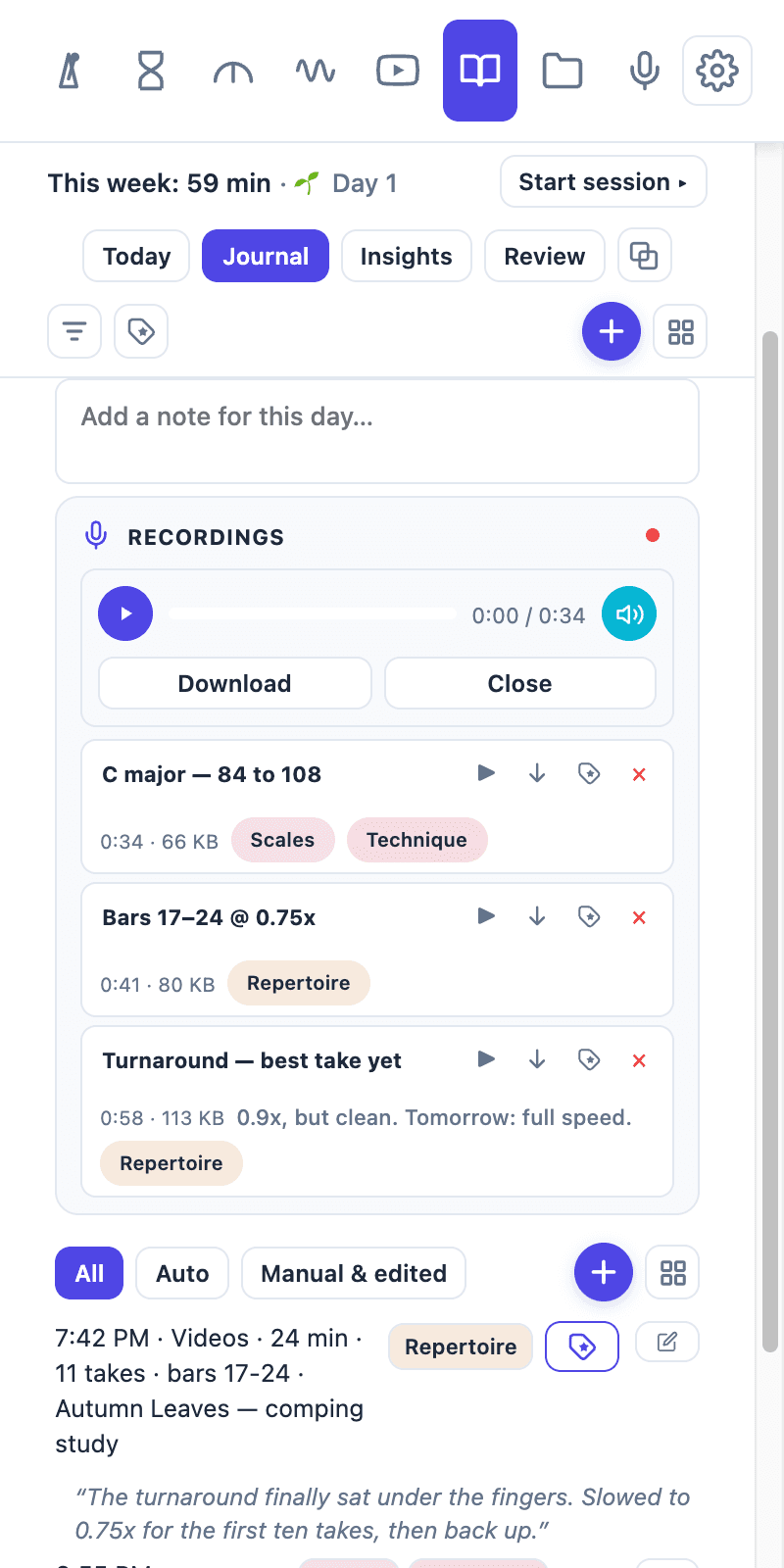
The fix isn’t more discipline. It’s making the journal need less of it. Split the entry into what a machine can capture and what only you can say. Dates, durations, tempos, which tools you used: capturable, automatically, with zero effort on your worst day. What broke and what’s first tomorrow: yours, thirty seconds, and worth it. When the countable half logs itself, the streak survives the tired days, and the record finally tells the truth about them.
The weekly five minutes
Writing the journal is half the practice; reading it is the other half. Once a week, skim the lines and ask two questions. Where did the time actually go? The answer regularly embarrasses the plan (three sessions on the song you love, none on the one you claimed was the priority). What has been stuck longest? A passage appearing three weeks running at the same tempo isn’t asking for more reps; it’s asking for a different approach: slower, smaller, looped, or recorded and actually listened to. The journal can’t practice for you, but it’s the only thing in the room that remembers what you tried, and that makes it the closest thing to a teacher most self-taught musicians ever hire.
Common questions
What should you write in a practice journal?
Is a paper journal or an app better?
How often should I review a practice journal?
What if I skip days, is the journal ruined?
Doesn't tracking everything make practice feel like homework?
Or skip the setup and practice in one panel
Tempo Kit puts the metronome, tuner, drone, timer, and the video controls in a single browser side panel beside whatever you're learning, and logs the session for you while you play. Free core tools, no account.
Keep reading
How to practice with a Drone for Better Intonation
The oldest intonation tool there is, and the one most people skip. Tune your guitar to it by ear, practice scales over it, and hear every note against something fixed.
How to Practice With a Metronome
Where to set the click, when to move it up, why you keep losing it, and the muted-strings trick that trains timing before technique gets in the way.
Why Slow Practice Works
Speed is a by-product of accuracy, not a separate skill. What slow practice is actually doing to your playing, how slow to go, and how to climb back up.
How Long Should You Practice Every Day?
The honest answer: less than you think, more often than you're managing. What focused time buys you at each level, and what to do with a five-minute day.
How to Build a Consistent Practice Routine
Routines don't fail from laziness. They fail from setup friction and a fried brain at 9pm. Here's how to build one that survives a long day.
Music Practice Routines You Can Actually Use
Stop explaining practice and just tell me what to do. Copyable 5, 15, 20, and 30-minute routines built for the amount of time and energy you actually have today.