In this guide
Why Recording Yourself Makes You Improve Faster
The player and the listener in your head are two different people, and while you're playing, the listener is barely home. A thirty-second recording puts them in the same room, which is why it's the fastest feedback loop available to a musician without a teacher standing behind them.
6 min read
The short answer
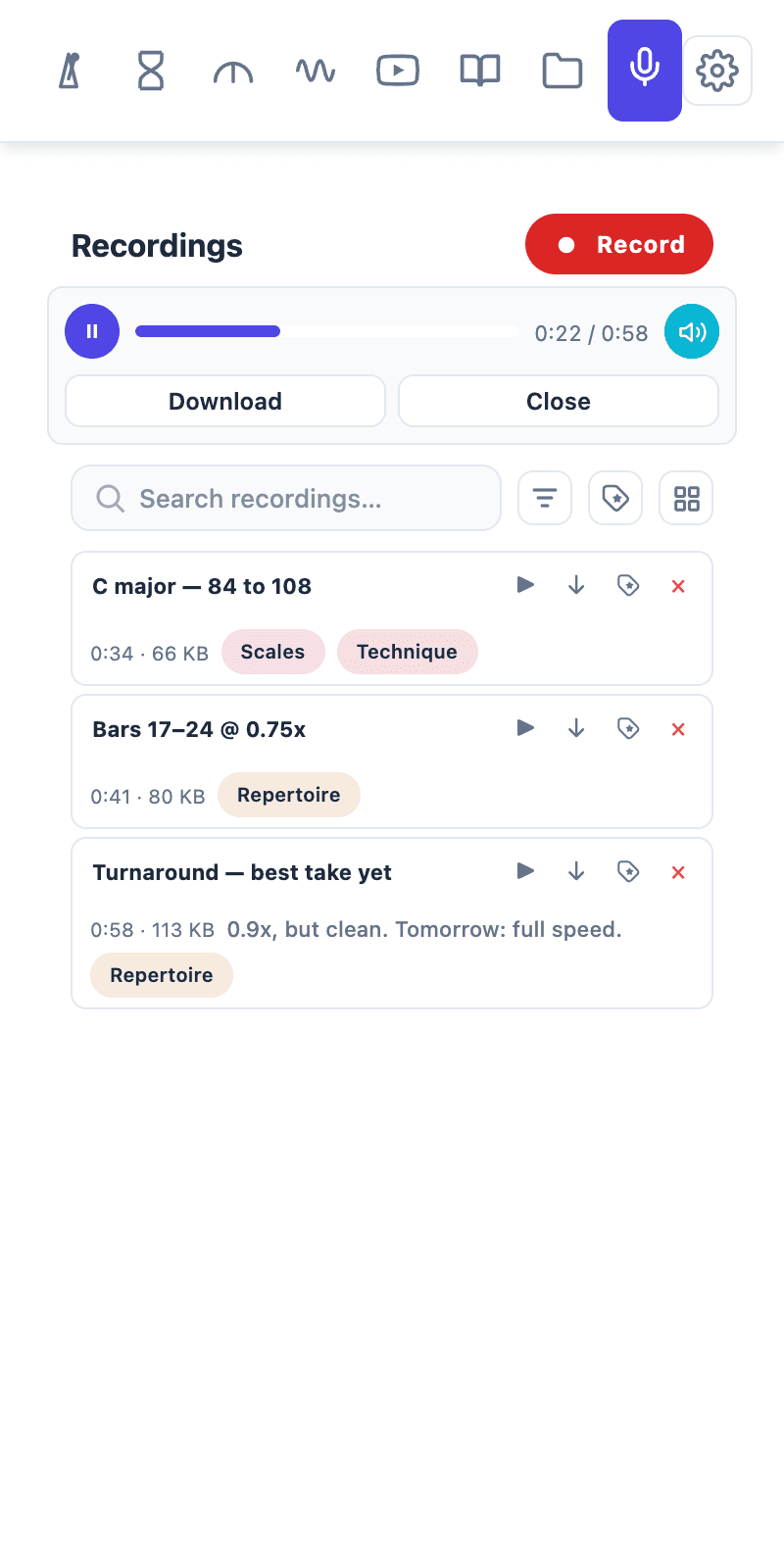
Record thirty seconds before you work on a passage and thirty seconds after. While you play, your attention is spent on playing, so you hear a flattering summary; on playback you hear what’s actually there. Listen once for timing and once for sound, then write down one thing to change. The phone in your pocket is more than good enough, or you can record directly in your browser with Tempo Kit.
The two-ears problem
Playing an instrument spends nearly everything you have (fingers, timing, reading, remembering what comes next). Listening, real listening, is a casualty of that budget: while you play, you hear a simplified, flattering summary of what’s happening, with the gaps filled in by what you intended. This isn’t a character flaw; it’s simply how much attention you have to go round. The ears you play with and the ears you listen with are two different ears.
A recording ends the arithmetic. On playback, execution costs nothing, so the full listening budget shows up, and suddenly you hear the rush into bar three, the note that never quite rang, the tempo sagging under the hard fill. A teacher provides this from the outside; it’s a large part of what lessons are. A recording is the self-serve version, and it costs one tap.
What playback catches that playing can’t
- Rushing (the universal one). Almost everyone compresses time under difficulty or excitement, and almost no one can feel it while playing. On the recording it’s unmissable, especially against a click.
- Tempo sag in the hard bar. The passage slows where it hurts and recovers after, which is felt as “made it through” but heard as a limp.
- Dynamics flatter than they felt. The contrast you were sure you played often barely registers on tape. What feels dramatic from inside is usually a nudge.
- Notes that don’t actually ring. Touched, fingered, technically played, but not sounding. The felt version had them; the recording doesn’t.
- The noise floor. String squeaks, key clatter, buzzes, breath, pedal thumps, chair creaks, the texture you’ve learned to unhear live, which everyone else hears first.
The 30-second protocol
The version of this habit that survives contact with real life is small and runs inside a normal session:
- Record the passage once, before working on it. Thirty seconds, one take, no warm-up for the camera. This is the “before”, so resist the urge to redo it.
- Practice as planned: fifteen or twenty minutes on that passage, slow and honest.
- Record it again. Same thirty seconds. That’s the “after.”
- Listen to the pair once, one focus per pass (timing first, sound second) and write one line about what changed and what’s still broken. (That line goes in the journal, where tomorrow will find it.)
The before/after pair is the quiet motivation engine in all of this. Improvement across weeks is too slow to feel, but improvement across one session, heard back to back, is unmistakable, and it’s the proof of progress most players never give themselves. Twenty minutes of work you can literally hear paying off changes how the next session feels.
About the cringe
The honest obstacle: the first playbacks are uncomfortable, sometimes enough that people quietly stop. Worth knowing, then, that the discomfort is a bug in the listener, not the playing. You’ve heard a flattering internal version of yourself for years (of your instrument, and if you sing, of a voice that physically differs from the broadcast one) and the recording is simply the first honest mirror. Everyone hates it at first. It fades within a couple of weeks of regular listening, and what replaces it is valuable: the recording stops being a verdict and becomes information. Listening for one thing at a time speeds this up: a pass hunting rushed beats is analysis; a pass absorbing a global judgment of your worth is just pain.
There is a useful side effect once the cringe fades. A red record light produces a mild, genuine version of performance pressure, which makes recording the cheapest available rehearsal for playing in front of people: playing well when you are nervous.
Keep them
Session clips are working feedback and can be disposable, but save a dated take of your current piece every few weeks, and don’t delete the old ones. Six months in, that archive becomes the definitive answer to the 3am question every self-taught musician asks: am I actually getting better, or just getting used to it? Play the take from January. The difference will be larger than you believed, because you’ve been raising your standards at the same rate you’ve been improving, which is precisely why it never feels like progress from inside. The tape doesn’t adjust its standards. Trust the tape.
Start now :D
Common questions
Why do I sound worse on recordings than I think I do?
Should I record audio or video?
How often should I record myself?
Do I need a good microphone to record practice?
What should I listen for when I play it back?
Or skip the setup and practice in one panel
Tempo Kit puts the metronome, tuner, drone, timer, and the video controls in a single browser side panel beside whatever you're learning, and logs the session for you while you play. Free core tools, no account.
Keep reading
How to practice with a Drone for Better Intonation
The oldest intonation tool there is, and the one most people skip. Tune your guitar to it by ear, practice scales over it, and hear every note against something fixed.
How to Practice With a Metronome
Where to set the click, when to move it up, why you keep losing it, and the muted-strings trick that trains timing before technique gets in the way.
Why Slow Practice Works
Speed is a by-product of accuracy, not a separate skill. What slow practice is actually doing to your playing, how slow to go, and how to climb back up.
How Long Should You Practice Every Day?
The honest answer: less than you think, more often than you're managing. What focused time buys you at each level, and what to do with a five-minute day.
How to Build a Consistent Practice Routine
Routines don't fail from laziness. They fail from setup friction and a fried brain at 9pm. Here's how to build one that survives a long day.
Music Practice Routines You Can Actually Use
Stop explaining practice and just tell me what to do. Copyable 5, 15, 20, and 30-minute routines built for the amount of time and energy you actually have today.